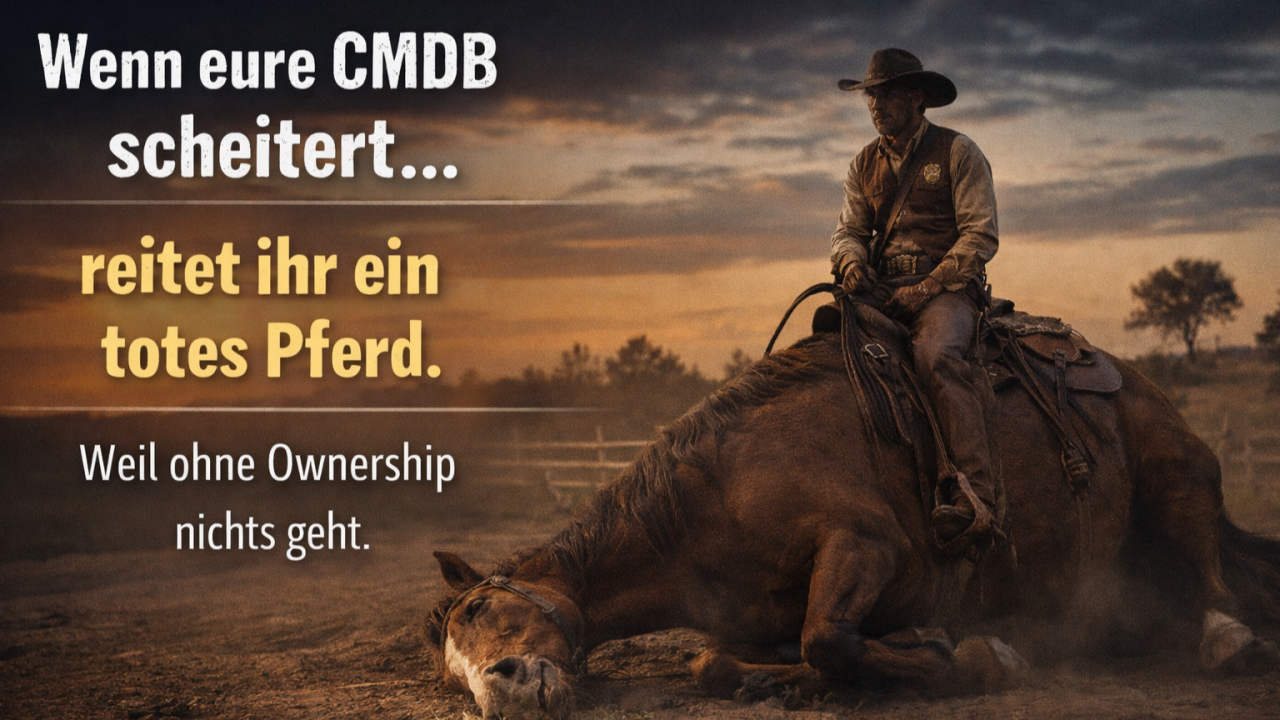
Es ist ein vertrautes Bild: Ein neues ITSM-Projekt startet, die Folien sind voller Versprechen. „Single Source of Truth." „Automatisierte Prozesse." „Vollständige Compliance." Und mittendrin, auf jedem dritten Slide: die CMDB.
Dann kommt der Alltag. Die Daten veralten. Niemand fühlt sich zuständig. Die Automatisierungen, die auf der CMDB aufgebaut werden sollten, laufen gegen eine Wand aus Halbwahrheiten und verwaisten Configuration Items. Das Projekt gilt offiziell als Erfolg. Die CMDB ist tot — und niemand hat es gemerkt.
„Das Problem ist nicht das Tool. Das Problem ist, dass wir so tun, als könnte ein Tool die Verantwortung übernehmen, die nur Menschen tragen können."
It is a familiar picture: a new ITSM project kicks off, the slides are full of promises. "Single source of truth." "Automated processes." "Full compliance." And right in the middle, on every third slide: the CMDB.
Then reality sets in. The data grows stale. Nobody feels responsible. The automations that were supposed to be built on the CMDB run into a wall of half-truths and orphaned Configuration Items. The project is officially declared a success. The CMDB is dead — and nobody noticed.
"The problem is not the tool. The problem is that we pretend a tool can take on the responsibility that only people can bear."
Organisierte Verantwortungslosigkeit
Die ehrliche Wahrheit: die meisten CMDB-Projekte scheitern nicht an der Technologie. ServiceNow, BMC, iTop — die Plattformen können das. Sie scheitern daran, dass niemand wirklich Verantwortung übernehmen will.
Im Management sieht man die CMDB als IT-internes Thema — zu technisch, zu operativ, nicht strategisch genug. In den Betriebsteams sieht man sie als zusätzliche Bürokratie, als jemand anderes Problem. Der Configuration Manager, oft mit zu wenig Mandat ausgestattet, verwaltet einen Prozess ohne Befugnis, Daten ohne Eigentümer und eine Plattform ohne politische Rückendeckung.
The honest truth: most CMDB projects do not fail because of technology. ServiceNow, BMC, iTop — the platforms can handle it. They fail because nobody really wants to take responsibility.
Management views the CMDB as an IT-internal matter — too technical, too operational, not strategic enough. Operations teams see it as additional bureaucracy, as someone else's problem. The Configuration Manager, often given too little mandate, manages a process without authority, data without owners and a platform without political backing.
Die drei stillen Killer jeder CMDB
- Kein benannter Eigentümer pro CI-Klasse — Daten gehören „allen" und damit niemandem
- Management-Buy-in endet nach dem Go-live — danach: Stille
- Discovery läuft, Governance nicht — technische Daten ohne menschliche Verantwortung
- No named owner per CI class — data belongs to "everyone" and therefore to no one
- Management buy-in ends after go-live — after that: silence
- Discovery runs, governance does not — technical data without human accountability
Das Pferd lässt sich zum Leben erwecken
Die gute Nachricht: Es braucht keine neue Plattform, kein größeres Budget, keinen externen Berater mit einem Framework-Deck. Es braucht politischen Willen und namentliche Verantwortung.
Was funktioniert, ist überraschend schlicht: Für jede relevante CI-Klasse gibt es eine Person — mit Namen, mit Verantwortung, mit regelmäßigem Review-Termin im Kalender. Nicht ein Team. Eine Person. Die weiß, dass schlechte Daten in ihrer Klasse ihr Problem sind.
Der Configuration Manager hört auf, Daten zu verwalten — und wird zur Instanz, die Eigentümer begleitet, Qualität sichtbar macht und den Dialog zwischen Betrieb und Management strukturiert. Eine Art Bibliothekarin des IT-Universums: Sie pflegt nicht alle Bücher selbst, aber sie sorgt dafür, dass jedes Buch einen Autor hat.
„Eine lebendige CMDB ist kein Projekt. Sie ist eine Entscheidung — die jeden Tag neu getroffen werden muss."
The good news: no new platform is needed, no bigger budget, no external consultant with a framework deck. What is needed is political will and named accountability.
What works is surprisingly simple: for every relevant CI class there is one person — named, accountable, with a regular review slot in the calendar. Not a team. One person. Who knows that poor data quality in their class is their problem.
The Configuration Manager stops managing data — and becomes the function that supports owners, makes quality visible and structures the dialogue between operations and management. A kind of librarian of the IT universe: she does not maintain every book herself, but she ensures that every book has an author.
"A living CMDB is not a project. It is a decision — one that must be made anew every day."
Drei Schritte, die wirklich etwas ändern
- CI-Klassen-Ownership formalisieren: Namentlich, mit Rollenbeschreibung, sichtbar für alle — nicht als Fußnote im Konzept, sondern als Governance-Artefakt
- Management in die Pflicht nehmen: Qualitäts-KPIs der CMDB gehören ins IT-Führungsmeeting, nicht nur ins Operations-Board
- Klein anfangen, sichtbar bleiben: Eine CI-Klasse, sauber, mit Eigentümer — und dann den Unterschied zeigen. Erfolge brauchen Zeugen.
Das tote Pferd wartet darauf, dass jemand sagt: Das gehört mir. Ich kümmere mich darum. Kein Tool der Welt kann diesen Satz ersetzen. Aber wenn jemand ihn sagt — und es ernst meint — beginnt das Pferd zu atmen.
Die CMDB ist kein gescheitertes Konzept. Sie ist ein Spiegel: Sie zeigt uns, wie ernst wir es meinen mit Ownership, mit Qualität, mit Verantwortung. Was wir darin sehen, liegt an uns.
- Formalise CI class ownership: By name, with a role description, visible to all — not as a footnote in a concept document, but as a governance artefact
- Hold management accountable: CMDB quality KPIs belong in the IT leadership meeting, not just the operations board
- Start small, stay visible: One CI class, clean, with an owner — and then show the difference. Successes need witnesses.
The dead horse is waiting for someone to say: this is mine. I will take care of it. No tool in the world can replace that sentence. But when someone says it — and means it — the horse begins to breathe.
The CMDB is not a failed concept. It is a mirror: it shows us how serious we are about ownership, quality and responsibility. What we see in it is up to us.

Frank Eck ist Gründer und Geschäftsführer der Flow-IT GmbH, einer unabhängigen ServiceNow-Beratung mit Sitz in Deutschland und einem Competence Centre in der Slowakei.
Hinweis: Dieser Artikel wurde mit Hilfe eines KI-Avatars erstellt.